I've thought of the 'why' for sometime and dismissed the question consciously because I'd made peace with it. But only after reading this post from Mr. Miller, did I feel a need to articulate it. People ruminate about the physical and temporal costs of training - I see a post like this on blogs about once a month. I have always framed it in another light: As low as the possibility of violence is for all of us in the developed world, and as high as the rigors of training might be, the physical and emotional costs of peril and violence can be enormous even if it happens once. Training - both physical and technical - is just like buying insurance for your business or saving for the future: just because you might never need that money doesn't mean you shouldn't have it. Having that extra money gives you peace of mind that is disproportionate to the amount of money that you saved. That peace of mind informs dozens of decisions that have nothing to do with the actual investment. There is a tangible value in that. In the same way, training and thinking about minimizing physical risk and danger synergizes with other aspects of your life to make that physical and temporal investment pay dividends in visible and invisible ways.
In short, how much time and money would you invest in becoming a better person, a tougher person? A person less likely to be confronted, a person less likely to be attacked or victimized? To do things out of love is a great motivation. But love can't be the only basis upon which you do things. There are plenty of things that we don't particularly love or enjoy - like saving money - that we should do and plenty of things that certain people love that they shouldn't do. Smokers love to smoke - just because they love it doesn't mean they should do it. I feel as though martiality and thinking about violence, confrontation, conflict are one of those things that we should do and learn regardless of our attitude towards it. By framing it merely in subjective terms of love, fun and enjoyment, I feel it kind of reduces the endevour to something that is arbitrary and banal - like any other hobby that people delight in. We should reach for a deeper motivation - a more profound calling to this pursuit. Protecting yourself - being a strong creature worthy of respect from others, a natural deterrent to violence - this isn't something to pursue just because its fun or because you enjoy it. This is a quality that all humans should build within. We should teach it to little boys and little girls - little boys should grow up knowing that if they try to hurt a girl, the average girl knows how to hurt boys. We shouldn't live in a world where everyone can be made a victim. We should live in a world where people operate with open eyes, know how to protect themselves physically, mentally, spiritually, and prepare for the future.
Wednesday, March 5, 2014


Tuesday, November 19, 2013
The Essential Reading list
I've been doing more reading than writing and its time to rectify that. Today is the start of a series of ten posts and reviews for the most essential texts on Karate that I have come across. These books are treasures to me. I recently moved in with the love of my life and she asked me when we were moving what was the most important things to take with me. And I looked at my little room, my little bed, my phone and laptop, my shoes, my clothes. My black belt. And then my eyes floated up to my bookshelf - to the top shelf. These are the books on my top shelf. They are what I would save from my room if it were engulfed in flames. Were it not for these words and ideas I would be a very different person, a lesser person. I hope that my enthusiasm in presenting them will encourage you to look for them yourself. And while I may rank them, they are, in my humble opinion, all essential reading for the true deshi - the true karateka.
tbc...
tbc...
Friday, July 12, 2013
Longevity in the Arts
Coach Scully discusses the reality of training and the mindset of acquiring longevity. High quality thinking and explanation, easily applicable to any martial art.
How to Train BJJ and Grappling for a Long Time - Grapplers Guide Soapbox - YouTube: "http://www.youtube.com/watch?v=MyP0V2bjqxA&feature=share&list=PL5AE60B2CBD730D14"
'via Blog this'
How to Train BJJ and Grappling for a Long Time - Grapplers Guide Soapbox - YouTube: "http://www.youtube.com/watch?v=MyP0V2bjqxA&feature=share&list=PL5AE60B2CBD730D14"
'via Blog this'
Thursday, June 20, 2013
Review: Shotokan Secret by Bruce Clayton
I read this a few months back and wanted to put my summary thoughts into the same place.
***
***
Clayton makes a lucid argument that a lot of modern karate's
development occurred in the lifetime of Sokon Matsumura and that most of what
we know as karate was created by Okinawan nobility (Shuri-te) for the purpose
of protecting the king, not by farmers or laborers (Naha-te and Tomari-te).
This lines up with Kenei Mabuni's sentiment that Shuri-te is the true
root of karate, despite his father's inclusion of Naha-te kata in the
Shito-Ryu. He also adds a lot of context to the idea of "village-te"
by pointing out that the area between Shuri Castle, Naha harbour and the
village of Tomari could all fit into Central park in Manhattan - suggesting
that it would have been mostly impossible for a Tomari-te or Naha-te to develop
in isolation (everyone knew everyone else). Finally he gives a great
historical sketch of the difficulties faced by Okinawa being caught between
China and Japan with the periodic influx of rowdy foreign ships using the
undefended port of Naha whenever it was conveneint - which was of course
punishable by death under the Tokugawa shogunate - all while the Okinawans were
more or less, weaponless.
However by saying that Shuri is true karate, that most of karate is the work of Matsumura and Itosu and that Shotokan is the true lineage of karate, he manages to completely takes for granted the hundreds of years where indigenous fighting arts would have been developing inOkinawa . "Okinawa-te" or "Ti' was a
combination of native fighting methods and Kung Fu that had been coming to the
island for centuries. He dismisses the hundreds of years when these arts
would have been exposed to Okinawans - both the nobility and the commoners -
and then says that Shuri-te is somehow a purer form of karate which by
extension makes Shotokan the purest modern style. All things that he
can't possibly know. And all things that, even if they were true, never
made any karateka safer or better - an empty comparative exercise. He
uses imprecise terms like "linear karate" to describe Shuri-te,
calling it a revolution, as if no one punched in straight lines before
Matsumara. He takes the expression 'Ikken hissatsu' in its utmost literal sense
- one strike, one kill - as if it is commonly held that these men often killed
people with one punch - and says that it is what sets Shotokan karate above and
beyond other styles. I'm really curious if Clayton possesses the ability
to kill me with one punch. Unnecessary conjecture on almost every page.
He makes contradictory statements - at one point he says that Ikken
hissatsu has nothing to do with vital points, only to later reverse his
statement; at another he says that sabaki and footwork was a problem that
linear karate solved, later he says that sabaki is good.
Incredibly, a book that was badly in need of an editor, in fact had 5 editors. Removed of its bias, it could have been a classic for all karateka, despite its focus on Shotokan. In the end it just descends into a thinly veiled apology for Shotokan practice, while subtly diminishing most of the other lineages of karate and most of the other martial arts generally - but IN THE SAME BREATH claims that most of the virtues of Shotokan karate are actually hidden!?! Which is childish, unhelpful and false. Haven't martial artists gotten to the point where we can all agree that people make a style what it is, not vice versa? That the "best" style practiced lazily, badly, without direction or introspection, will produce a weak person and poor karate? That there are no 'secrets' that can't be determined on your own through hard, honest training? Matsumura wasn't a great karateka because he killed people with one punch (which, by the way, he didn't) or punched in straight lines. He was great because he'd mastered a discipline and that discipline allowed him to subdue an attacker. It is likely that his mastery would have involved finding a proper balance between advancing AND withdrawing, punching and blocking, moving in straight lines and flanking, strengthening body and mind. Then he passed it along.
Clayton is like the person who looks through a pinhole to try and appreciate the night sky or as Bruce Lee said "focuses on the finger that points at a star, while missing all the heavenly glory". Karate isn't good or effective because of one or two arbitrary things - pulling our fist to our hip or punching in a straight line. It is good and effective because karateka work long and hard to make it good and effective.
However by saying that Shuri is true karate, that most of karate is the work of Matsumura and Itosu and that Shotokan is the true lineage of karate, he manages to completely takes for granted the hundreds of years where indigenous fighting arts would have been developing in
Incredibly, a book that was badly in need of an editor, in fact had 5 editors. Removed of its bias, it could have been a classic for all karateka, despite its focus on Shotokan. In the end it just descends into a thinly veiled apology for Shotokan practice, while subtly diminishing most of the other lineages of karate and most of the other martial arts generally - but IN THE SAME BREATH claims that most of the virtues of Shotokan karate are actually hidden!?! Which is childish, unhelpful and false. Haven't martial artists gotten to the point where we can all agree that people make a style what it is, not vice versa? That the "best" style practiced lazily, badly, without direction or introspection, will produce a weak person and poor karate? That there are no 'secrets' that can't be determined on your own through hard, honest training? Matsumura wasn't a great karateka because he killed people with one punch (which, by the way, he didn't) or punched in straight lines. He was great because he'd mastered a discipline and that discipline allowed him to subdue an attacker. It is likely that his mastery would have involved finding a proper balance between advancing AND withdrawing, punching and blocking, moving in straight lines and flanking, strengthening body and mind. Then he passed it along.
Clayton is like the person who looks through a pinhole to try and appreciate the night sky or as Bruce Lee said "focuses on the finger that points at a star, while missing all the heavenly glory". Karate isn't good or effective because of one or two arbitrary things - pulling our fist to our hip or punching in a straight line. It is good and effective because karateka work long and hard to make it good and effective.
Tuesday, April 23, 2013
Kuro Obi
So I don't forget...

カナダ 千唐 流
和 忍
心 技 体
力必達
Ka-na-da Chi-tou-ryu
Wa Nin
Shin Gi Tai
Tsutomereba Kanarazu Tassu
Canada Chito-ryu
Peace and perserverance
Mind technique body
Endeavour ceaselessly to succeed

カナダ 千唐 流
和 忍
心 技 体
力必達
Ka-na-da Chi-tou-ryu
Wa Nin
Shin Gi Tai
Tsutomereba Kanarazu Tassu
Canada Chito-ryu
Peace and perserverance
Mind technique body
Endeavour ceaselessly to succeed
Friday, March 29, 2013
Verification
Kenji Ushiro uses a word that I have yet to hear any really notable martial artist use. The word is verification. He uses it often and precisely. Kata is practice. What it teaches must be verified in bunkai and kumite.
I raise this issue because I was watching a very precise and technically marvelous kata presentation by the Japanese female champion, Rika Usami:
To which I commented in the comments section below:
Her kata is sharp and decisive.
A user, Ivan Carvalho, made this response:
your argumet is fail because in a competition you don't have do see the bunkai. they know the kata she is doing. she not create new one. and is individual she must be avaliaded by the kata himself not for the bunkai. sorry for my english
Ivan, don't worry. I'm sure I speak your first language worse than you speak english. And beyond that, he's right. My argument is flawed. The purpose of Ms. Usami's kata is not to verify what she knows. It is to show the technical brilliance necessary under a specific set of guidelines in order to win at a kata competition. Ivan rightly points out that no one expects her to demonstrate the bunkai and beyond that the bunkai are known - she isn't trying to educate anyone.
I suppose that I take issue with the premise of kata competition itself. The premise is that if Ms. Usami's kata follows the evaluative criteria of the judges better than another competitors then her kata is "better" and she should win. But what does "better" mean in this case? Does it mean that she should be better able to defend herself? Attack someone? Would she be able to defeat her fellow competitors if they were to attack her?
It should be clear that though she may demonstrate magnificent body control alone, that doesn't automatically mean that it will translate protecting her against true attack. I also think it should be clear (though obviously it is not) that the translation part is the most important thing of all. That translating your individual practice into functional technique against an attacker is the point of practicing alone.
Too much of karate today is this broken, dissassembled practice where everything is disconnected and addressed in separate boxes. Kata has nothing to do with kumite, kihon nothing to do with bunkai. Goshin has nothing to do with sport, Wado has nothing to do with Shito, etc. Instead there must be reassembly, unity. The parts must be unified. Kata should tie together with bunkai. They must verify one another and show that you are making progress.
Instead, kata competition today is a lot like bodybuilding competitions. Bodybuilders look very strong. But it is all appearance. If they were really strong, they would be able to compete in strongman competitions, actually lifting weights rather than appearing to be able to lift weights. They would lift weights as they struck their poses. If they were really functional, then the finest athletes in the world would look like bodybuilders. But neither is true. Kata is not meant to be merely the appearance of having control or focus. It is supposed to be practice of control and focus that gives you control and focus for when it is not practice. But to praise a kata "performance" without determining whether it actually allows one to perform when it counts - how is that different from marveling at the size of a muscle without finding out how much it can lift?
I raise this issue because I was watching a very precise and technically marvelous kata presentation by the Japanese female champion, Rika Usami:
To which I commented in the comments section below:
Her kata is sharp and decisive.
A user, Ivan Carvalho, made this response:
your argumet is fail because in a competition you don't have do see the bunkai. they know the kata she is doing. she not create new one. and is individual she must be avaliaded by the kata himself not for the bunkai. sorry for my english
Ivan, don't worry. I'm sure I speak your first language worse than you speak english. And beyond that, he's right. My argument is flawed. The purpose of Ms. Usami's kata is not to verify what she knows. It is to show the technical brilliance necessary under a specific set of guidelines in order to win at a kata competition. Ivan rightly points out that no one expects her to demonstrate the bunkai and beyond that the bunkai are known - she isn't trying to educate anyone.
I suppose that I take issue with the premise of kata competition itself. The premise is that if Ms. Usami's kata follows the evaluative criteria of the judges better than another competitors then her kata is "better" and she should win. But what does "better" mean in this case? Does it mean that she should be better able to defend herself? Attack someone? Would she be able to defeat her fellow competitors if they were to attack her?
It should be clear that though she may demonstrate magnificent body control alone, that doesn't automatically mean that it will translate protecting her against true attack. I also think it should be clear (though obviously it is not) that the translation part is the most important thing of all. That translating your individual practice into functional technique against an attacker is the point of practicing alone.
Too much of karate today is this broken, dissassembled practice where everything is disconnected and addressed in separate boxes. Kata has nothing to do with kumite, kihon nothing to do with bunkai. Goshin has nothing to do with sport, Wado has nothing to do with Shito, etc. Instead there must be reassembly, unity. The parts must be unified. Kata should tie together with bunkai. They must verify one another and show that you are making progress.
Instead, kata competition today is a lot like bodybuilding competitions. Bodybuilders look very strong. But it is all appearance. If they were really strong, they would be able to compete in strongman competitions, actually lifting weights rather than appearing to be able to lift weights. They would lift weights as they struck their poses. If they were really functional, then the finest athletes in the world would look like bodybuilders. But neither is true. Kata is not meant to be merely the appearance of having control or focus. It is supposed to be practice of control and focus that gives you control and focus for when it is not practice. But to praise a kata "performance" without determining whether it actually allows one to perform when it counts - how is that different from marveling at the size of a muscle without finding out how much it can lift?
Thursday, March 7, 2013
The Top 10
It occurs to me that I have, in the last week, made two comments on blogs that I follow about martial artists that I consider the creme of the crop - the inspirations that I cling to in my mind when I step into the dojo and when I practise alone. And yet, though who they are and how they move is deeply embedded in my mind, I've never actually taken the time to simply commit to writing who these magnificent budoka are that guide the ultimate goals of my training. Thus, if for no one else's sake but my own, are my list of the top 10 budoka...
10. Morio Higaonna
The Goju master, the man that Donn Draeger once called "The most dangerous man in Japan in a real fight". I have videos from him from the 70s where he's training harder than I've yet to train in my whole life. Higaonna-sensei was really one of the foundational characters in my love for karate. As karateka we've all had moments where we looked at uke-waza, tried to use it in kumite, and thought to ourselves, "This can never work." I was disillusioned and my karate began to waver as I got older. I then remember once reading him saying that if someone tried to touch you your uke should be able to smash and break your attacker's arm. The implication was like a nuclear explosion in my mind - good uke-waza can and should be offensive as well as defensive: it should compromise the attacker while it protects self. That was a life-changing insight in my karate, the first place where it occurred to me that you could be attacking and defending at the same time. His life-long dedication and unquestioned love of karate is firm in my mind whenever I practice.
9. Gichen Funakoshi

Mr. Shoto himself, the father of modern karate, the founder of the Shotokan and one of if not the most important reason for the growth and expansion of karate in the world. Funakoshi was the most ardent advocate for karate in mainland Japan, the chief emissary from Okinawa to Japan. I place him in ninth place but in reality he is co-equivalent with number 8 on this list, a man that he reportedly did not get along with very well, Choki Motobu. Funakoshi and Motobu, to me, represent the two extreme positions in karate thought: Funakoshi the idealized representative of karate as do, Motobu the idealized representative as karate as jutsu. It is clear that Funakoshi Sensei believed with all his heart what karate could do for the spirit, that its ultimate aim lay beyond victory or defeat, but "in the perfection of the character". This is an important development in karate, as the deeper spiritual and psychological potentials of the training are in reality a rather novel and fashionable development, not at all in keeping with the majority of karate history. But it was an immensely significant development and if karate had remained simply underground, no-holds barred brutality, it would be less than half of what it was meant to be.
8. Choki Motobu

Again, co-equivalent with Funakoshi, "Motobu the monkey" is the voice of practicality in karate that is more or less lost to the ages. Had he founded an enduring style or codified his thinking into a publication, I feel he would be as important a father to karate as Funakoshi. But his abrasive manner in life has clearly had lasting consequences upon his legacy - few dojos have a picture of Motobu hanging at the front of the class. Which is a genuine shame, because what he has to say is simple and essential: If you've never been punched hard, in the face, you don't and can't know karate. Getting punched hard in the face is the reason why you practice in the first place. It's to prevent having to feel that pain, that visceral brutality, that humbling vulnerabilty. To deal with that brutality, the nature of violence, you must face it and be willing to dispense it to others. This is the hardness of karate-jitsu, the "go" in Goju, from which the softness of karate-do, the "ju" in Goju, must emerge. To be unwilling to fight when you are unable to fight is meaningless - it isn't a measure of your character, it's just a necessity. Karate-do, the strength to not have to fight, can only exist after you have karate-jitsu, the ability with technique to destroy your attacker at a stroke. The peace must come first from a place of being willing and able to wage war. But so much of karate starts from the perspective of character without the harsh reality that builds it in the first place. What little of his thought has been put onto paper has given me a clear appreciation for bumps, bleeding and bruises - they are not nuisances or failings of my karate, they are proof. Proof that I'm going in the right direction.
7. Tetsuhiro Hokama

The master of the Kenshi-kai, Hokama Sensei is a kobudo and karate disciple that embodies the idea of the musha shugyo, the warrior's pilgrammage, the lifelong journey. Hokama Sensei runs a karate museum in Okinawa and is basically cited in every book on karate worth a damn. His commitment to the spiritual, physical and academic dimensions of karate are strong in my mind and have left a lasting impression. It isn't enough for me to love karate in a physical sense. My love must ultimately manifest itself not only in what I learn and what I teach: I must also make my love of karate express itself through my own unique contribution to the academic literature of karate. Karate, more than any other martial art, needs a strong literary foundation, it needs a museum. Unlike kendo or judo or aikido, karate is dispersed, far-flung and most of the most important things done on one side of the karate world are all but unknown to the other. If we, who understand what karate can offer that people lack, truly value karate, we must deepen the meaning of the practice and disseminate it in a responsible cohesive and practical way. History and research is an obvious source of inspiration in strengthening karate today and producing learning material relevant to our age is essential to strengthening karate tomorrow.
6. Tetsuzan Kuroda
Not a karateka, but nonetheless, one of the finest budoka in all the world, Master Kuroda is the sensei of the Shinbukan Kurodo dojo and the heir to five unique centuries-old martial disciplines (Komagawa-Kaishin ryu kenjitsu, Shishin-Takuma ryu jujitsu, Tamiya ryu-iaijitsu, Tsubaki-Kotengu ryu bojitsu, Seigyoku-Ogurirryi Sakkatsujitsu). Impressive on paper but what is his technique like?
In a word, lightning.
Kuroda Sensei is the physical embodiment of a very important principle of budo - one that my own sensei had shown me but I never realized or could put into words. Kuroda sensei is not big. He is not broad. He does not appear strong in the conventional sense of the word. But budo doesn't care at all about that. Budo is not about what you don't have. It about maximizing what you do. Kuroda sensei doesn't have big muscles or great weight. But speed has nothing to do with conventional notions of strength, true speed comes from form and method. The smallest person in the world with a weapon is just as if not more dangerous than the largest person in the world with the same weapon. This is the difference between budo and other methods. Other methods of increasing performance are about adding: adding strength, adding weight. Budo is about subtracting - subtracting tension, subtracting fear. Subtracting ego until all that is left is the moment and the movement.
5. Bruce Lee

I shouldn't have to speak long about this. So I won't. Instead I'll just copy a well-known anecdote about the master of Jeet Kune Do (which is one of the few martial philosophies made in the last 50 years that I actually recognize as original):
“Bruce had me up to three miles a day, really at a good pace. We’d run the three miles in twenty-one or twenty-two minutes. Just under eight minutes a mile [Note: when running on his own in 1968, Lee would get his time down to six-and-a half minutes per mile]. So this morning he said to me “We’re going to go five.” I said, “Bruce, I can’t go five. I’m a helluva lot older than you are, and I can’t do five.” He said, “When we get to three, we’ll shift gears and it’s only two more and you’ll do it.” I said “Okay, hell, I’ll go for it.” So we get to three, we go into the fourth mile and I’m okay for three or four minutes, and then I really begin to give out. I’m tired, my heart’s pounding, I can’t go any more and so I say to him, “Bruce if I run any more,” –and we’re still running-”if I run any more I’m liable to have a heart attack and die.” He said, “Then die.” It made me so mad that I went the full five miles. Afterward I went to the shower and then I wanted to talk to him about it. I said, you know, “Why did you say that?” He said, “Because you might as well be dead. Seriously, if you always put limits on what you can do, physical or anything else, it’ll spread over into the rest of your life. It’ll spread into your work, into your morality, into your entire being. There are no limits. There are plateaus, but you must not stay there, you must go beyond them. If it kills you, it kills you. A man must constantly exceed his level.”
- John Little
If it kills you, it kills you. If the martial arts doesn't cause you to take a good hard look at your mortality - if it doesn't make you come to terms with the fact that this could be the last day of your life - what's the point? We're either living, or we're just being afraid of dying.
4. Yoshimitsu Onaga > Michiko Onaga

Onaga Sensei and his daughter Michiko are the kancho of the Shinjinbukan Shorin-Kai. His system and his dedication to the cause of incorporating the oldest principles of Okinawan fighting into modern karate are a philosophical bright spot in the karate world. Onaga's method, which he calls Ti, is a reconciliation of the flaws of modern karate with the invisible consideration of fighting that were more or less assumed in old Okinawan fighting. Onaga is fond of saying that Ti is the missing dimension to karate. And I feel strongly that there is merit to this claim, and only one other budoka has ever made me feel that their was a dimension to karate that was truly invisible (see number 1).
Onaga's daughter is by his own admission, his greatest student and the finest karateka he has ever known. She has now taken the helm of his organization and with good reason. So often in the fighting arts a dojo or discipline is administratively or technically left in the hands of a familial descendant with a questionable claim to that legacy. Not so with Michiko Onaga. Onaga Sensei, probably without her even realizing it, embodies, like Kuroda Sensei, the reality that budo is trying to make us aware of - size doesn't have to matter. It can matter, and most people think that it matters alot, but it doesn't have to. Onaga moves with a quiet fluidity, a deadly grace, that is hard to describe. When she punches your stomach, she is aiming not for your solar plexus, she has the expectation that her knuckle will hit your spine. When she kicks she expects to hit your chin every time, exactly the way Anderson Silva did against Vitor Belfort to devastating effect. This is the maximization of all the small details of karate that makes the cohesive whole of karate so formidable. And this is how the small can control the big.
3. Kenwa Mabuni > Kenei Mabuni
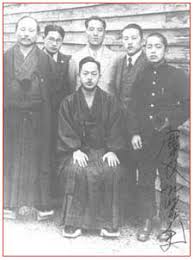


The Mabuni family need no introduction. Kenwa Mabuni was virtually a walking repository of karate and probably has the strongest claim to the person in history that came closest to knowing karate in its entirety. Gichen Funakoshi called him "Mabuni the technician". His masters, Anko Itosu and Kanryo Higaonna, the masters of the Shuri-te and Naha-te respectively, represent clear and unambiguous heirs to a lineage, a lineage that Mabuni meant to unite in his Shito-ryu. I don't know how successful it has been: Shito-ryu still has a massive amount of kata in its curriculum, so it might be more fair to say that Shito has combined Shuri and Naha-te rather than coalesced them. All the same, to read anything of Kenwa Mabuni is to get a clear glimpse of what karate was meant to be and what it could have been if he had lived longer or if enormous amounts of karate documentation hadn't been lost to the second World War.
Kenei Mabuni, Mabuni sensei's son, is Soke to one branch of the Shito family and his commitment to karate as budo is unquestioned. He makes perhaps the clearest and most measured analysis of the progress and future of karate in his book, Empty Hand, which unites the insights of his father with his lifetime of experience with karate. It also happens to be one of the most magnificent tomes on karate in the world, and I would hope that it serves as an inspiration to the other venerated members of the old guard of karate and the martial arts in general to put their insights into one place so that they might not be lost when their journeys on the Way come to an end.
2. Tsuyoshi Chitose > Shane Higashi


I have three debts in my life that cannot be repaid. Two are to my parents. The third is to my master, Shane Higashi and his master before him, Dr. Tsuyoshi Chitose. Like Mabuni, O'Sensei Chitose learned from major proponents of the Shuri-te and Naha-te, Shorin and Shohei, and created a discipline that meant to reconcile them. He did this by creating a curriculum that focused on a few key kata, reformatted them to incorporate what he thought mattered most based both on his knowledge karate and his knowledge of anatomy and physiology. He called his style Chito-ryu - the thousand-year Chinese style. What results is a karate that in old Chito-ryu manuals, O'Sensei says is "70% based on strength." I find that claim somewhat amusing but it in no way diminishes what I see in Chito-Ryu - a style that has no preference in kata, kihon, kumite, with a diverse range of clear bunkai, a technical set that ranges from striking to throws to locks and wrist manipulation, a kata dedicated to tai-sabaki, a discipline that puts a strong emphasis on falling and rolling, a style that incorporates some of the best and most unambiguous techniques from judo, jujitsu, aikido, and kendo. It is a comprehensive fighting system that O'Sensei created and I always try to honor his achievement by putting in the amount of time that is necessary to gain facility with even a small measure of it.
Higashi sensei is a good man. He isn't some Japanese jedi master, or a wizard. He's just a sometimes childish, sometimes goofy, sometimes cruel, sometimes strict, always effortlessly precise and everpresent teacher. When he shows you technique, you can understand why it works with your body and your eyes even if you can't understand it with your mind. He's the grandfather that I never really had. Putting into words the moments that I've spent with him diminishes them. Simply put, years from now long after he's gone, his face will smile down upon me from the front of my dojo.
1. Nikichi Zaha > Kenji Ushiro

Kenji Ushiro writes in his book "Karate and Ki" that if his father had died on the same day as his master, Nikichi Zaha, he would have to attend his master's funeral at his father's expense. I remember reading that the first time and thinking to myself what an awful father he must have had. But beneath that empty insight was a frightening question: was that level of commitment even possible? Was he telling the truth? Could you devote yourself that wholly to karate and to your master's memory that it would be even deeper than the bonds of family? I don't know that I can go that far.
But Kenji Ushiro has. And ultimately, that may be the reason why his karate is what it is. He is in my humble opinion, the most safe man in the entire world. By this, of course, I mean that if karate is meant to keep one safe from the aggression of others, no one is safer than Kenji Ushiro. Other people would call him the most dangerous man in the world, but he would see that as so beneath him as not even worthy of comment. His karate has moved beyond the level of what your feet and fist are doing. Beyond space, and time, into thought. He doesn't act based on what his mind perceives, what his eyes tell him. He acts on what his heart sees, what his opponent intends to do. His karate, his budo, pushes the boundaries of the possible.
The master of the Shindo-ryu is also a high level practitioner of Iaido. I have felt his strength, his abilities first-hand and my only doubts as to his skill is in my own abilities to comprehend or explain them. And when you ask him how he does these magnificent things, how he marshals these powers to keep himself safe he answers always the same...Always simple and always the same.
"気"
This word is pronounced ki. And we, as karateka, both in the east and west, largely have no idea what it means because it mostly defies definition. Both in English and in Japanese. So it is difficult. But it is, according to Ushiro, the missing dimension in the martial arts. I tend to quickly descend into a kind of madness when I wonder whether or not my karate is obtaining this undefinable thing that I can't see. I can only hope that it is and keep training hard and keep my ears and mind open, to stay on the lookout for it. But I have seen it and I have felt it and the most important thing is to believe what I saw and remember what I felt and search for that feeling. Karate is a feeling, isn't it?
10. Morio Higaonna


9. Gichen Funakoshi
Mr. Shoto himself, the father of modern karate, the founder of the Shotokan and one of if not the most important reason for the growth and expansion of karate in the world. Funakoshi was the most ardent advocate for karate in mainland Japan, the chief emissary from Okinawa to Japan. I place him in ninth place but in reality he is co-equivalent with number 8 on this list, a man that he reportedly did not get along with very well, Choki Motobu. Funakoshi and Motobu, to me, represent the two extreme positions in karate thought: Funakoshi the idealized representative of karate as do, Motobu the idealized representative as karate as jutsu. It is clear that Funakoshi Sensei believed with all his heart what karate could do for the spirit, that its ultimate aim lay beyond victory or defeat, but "in the perfection of the character". This is an important development in karate, as the deeper spiritual and psychological potentials of the training are in reality a rather novel and fashionable development, not at all in keeping with the majority of karate history. But it was an immensely significant development and if karate had remained simply underground, no-holds barred brutality, it would be less than half of what it was meant to be.
8. Choki Motobu
Again, co-equivalent with Funakoshi, "Motobu the monkey" is the voice of practicality in karate that is more or less lost to the ages. Had he founded an enduring style or codified his thinking into a publication, I feel he would be as important a father to karate as Funakoshi. But his abrasive manner in life has clearly had lasting consequences upon his legacy - few dojos have a picture of Motobu hanging at the front of the class. Which is a genuine shame, because what he has to say is simple and essential: If you've never been punched hard, in the face, you don't and can't know karate. Getting punched hard in the face is the reason why you practice in the first place. It's to prevent having to feel that pain, that visceral brutality, that humbling vulnerabilty. To deal with that brutality, the nature of violence, you must face it and be willing to dispense it to others. This is the hardness of karate-jitsu, the "go" in Goju, from which the softness of karate-do, the "ju" in Goju, must emerge. To be unwilling to fight when you are unable to fight is meaningless - it isn't a measure of your character, it's just a necessity. Karate-do, the strength to not have to fight, can only exist after you have karate-jitsu, the ability with technique to destroy your attacker at a stroke. The peace must come first from a place of being willing and able to wage war. But so much of karate starts from the perspective of character without the harsh reality that builds it in the first place. What little of his thought has been put onto paper has given me a clear appreciation for bumps, bleeding and bruises - they are not nuisances or failings of my karate, they are proof. Proof that I'm going in the right direction.
7. Tetsuhiro Hokama
The master of the Kenshi-kai, Hokama Sensei is a kobudo and karate disciple that embodies the idea of the musha shugyo, the warrior's pilgrammage, the lifelong journey. Hokama Sensei runs a karate museum in Okinawa and is basically cited in every book on karate worth a damn. His commitment to the spiritual, physical and academic dimensions of karate are strong in my mind and have left a lasting impression. It isn't enough for me to love karate in a physical sense. My love must ultimately manifest itself not only in what I learn and what I teach: I must also make my love of karate express itself through my own unique contribution to the academic literature of karate. Karate, more than any other martial art, needs a strong literary foundation, it needs a museum. Unlike kendo or judo or aikido, karate is dispersed, far-flung and most of the most important things done on one side of the karate world are all but unknown to the other. If we, who understand what karate can offer that people lack, truly value karate, we must deepen the meaning of the practice and disseminate it in a responsible cohesive and practical way. History and research is an obvious source of inspiration in strengthening karate today and producing learning material relevant to our age is essential to strengthening karate tomorrow.
6. Tetsuzan Kuroda
Not a karateka, but nonetheless, one of the finest budoka in all the world, Master Kuroda is the sensei of the Shinbukan Kurodo dojo and the heir to five unique centuries-old martial disciplines (Komagawa-Kaishin ryu kenjitsu, Shishin-Takuma ryu jujitsu, Tamiya ryu-iaijitsu, Tsubaki-Kotengu ryu bojitsu, Seigyoku-Ogurirryi Sakkatsujitsu). Impressive on paper but what is his technique like?
In a word, lightning.
Kuroda Sensei is the physical embodiment of a very important principle of budo - one that my own sensei had shown me but I never realized or could put into words. Kuroda sensei is not big. He is not broad. He does not appear strong in the conventional sense of the word. But budo doesn't care at all about that. Budo is not about what you don't have. It about maximizing what you do. Kuroda sensei doesn't have big muscles or great weight. But speed has nothing to do with conventional notions of strength, true speed comes from form and method. The smallest person in the world with a weapon is just as if not more dangerous than the largest person in the world with the same weapon. This is the difference between budo and other methods. Other methods of increasing performance are about adding: adding strength, adding weight. Budo is about subtracting - subtracting tension, subtracting fear. Subtracting ego until all that is left is the moment and the movement.
5. Bruce Lee
I shouldn't have to speak long about this. So I won't. Instead I'll just copy a well-known anecdote about the master of Jeet Kune Do (which is one of the few martial philosophies made in the last 50 years that I actually recognize as original):
“Bruce had me up to three miles a day, really at a good pace. We’d run the three miles in twenty-one or twenty-two minutes. Just under eight minutes a mile [Note: when running on his own in 1968, Lee would get his time down to six-and-a half minutes per mile]. So this morning he said to me “We’re going to go five.” I said, “Bruce, I can’t go five. I’m a helluva lot older than you are, and I can’t do five.” He said, “When we get to three, we’ll shift gears and it’s only two more and you’ll do it.” I said “Okay, hell, I’ll go for it.” So we get to three, we go into the fourth mile and I’m okay for three or four minutes, and then I really begin to give out. I’m tired, my heart’s pounding, I can’t go any more and so I say to him, “Bruce if I run any more,” –and we’re still running-”if I run any more I’m liable to have a heart attack and die.” He said, “Then die.” It made me so mad that I went the full five miles. Afterward I went to the shower and then I wanted to talk to him about it. I said, you know, “Why did you say that?” He said, “Because you might as well be dead. Seriously, if you always put limits on what you can do, physical or anything else, it’ll spread over into the rest of your life. It’ll spread into your work, into your morality, into your entire being. There are no limits. There are plateaus, but you must not stay there, you must go beyond them. If it kills you, it kills you. A man must constantly exceed his level.”
- John Little
If it kills you, it kills you. If the martial arts doesn't cause you to take a good hard look at your mortality - if it doesn't make you come to terms with the fact that this could be the last day of your life - what's the point? We're either living, or we're just being afraid of dying.
4. Yoshimitsu Onaga > Michiko Onaga
Onaga Sensei and his daughter Michiko are the kancho of the Shinjinbukan Shorin-Kai. His system and his dedication to the cause of incorporating the oldest principles of Okinawan fighting into modern karate are a philosophical bright spot in the karate world. Onaga's method, which he calls Ti, is a reconciliation of the flaws of modern karate with the invisible consideration of fighting that were more or less assumed in old Okinawan fighting. Onaga is fond of saying that Ti is the missing dimension to karate. And I feel strongly that there is merit to this claim, and only one other budoka has ever made me feel that their was a dimension to karate that was truly invisible (see number 1).
Onaga's daughter is by his own admission, his greatest student and the finest karateka he has ever known. She has now taken the helm of his organization and with good reason. So often in the fighting arts a dojo or discipline is administratively or technically left in the hands of a familial descendant with a questionable claim to that legacy. Not so with Michiko Onaga. Onaga Sensei, probably without her even realizing it, embodies, like Kuroda Sensei, the reality that budo is trying to make us aware of - size doesn't have to matter. It can matter, and most people think that it matters alot, but it doesn't have to. Onaga moves with a quiet fluidity, a deadly grace, that is hard to describe. When she punches your stomach, she is aiming not for your solar plexus, she has the expectation that her knuckle will hit your spine. When she kicks she expects to hit your chin every time, exactly the way Anderson Silva did against Vitor Belfort to devastating effect. This is the maximization of all the small details of karate that makes the cohesive whole of karate so formidable. And this is how the small can control the big.
3. Kenwa Mabuni > Kenei Mabuni
The Mabuni family need no introduction. Kenwa Mabuni was virtually a walking repository of karate and probably has the strongest claim to the person in history that came closest to knowing karate in its entirety. Gichen Funakoshi called him "Mabuni the technician". His masters, Anko Itosu and Kanryo Higaonna, the masters of the Shuri-te and Naha-te respectively, represent clear and unambiguous heirs to a lineage, a lineage that Mabuni meant to unite in his Shito-ryu. I don't know how successful it has been: Shito-ryu still has a massive amount of kata in its curriculum, so it might be more fair to say that Shito has combined Shuri and Naha-te rather than coalesced them. All the same, to read anything of Kenwa Mabuni is to get a clear glimpse of what karate was meant to be and what it could have been if he had lived longer or if enormous amounts of karate documentation hadn't been lost to the second World War.
Kenei Mabuni, Mabuni sensei's son, is Soke to one branch of the Shito family and his commitment to karate as budo is unquestioned. He makes perhaps the clearest and most measured analysis of the progress and future of karate in his book, Empty Hand, which unites the insights of his father with his lifetime of experience with karate. It also happens to be one of the most magnificent tomes on karate in the world, and I would hope that it serves as an inspiration to the other venerated members of the old guard of karate and the martial arts in general to put their insights into one place so that they might not be lost when their journeys on the Way come to an end.
2. Tsuyoshi Chitose > Shane Higashi
I have three debts in my life that cannot be repaid. Two are to my parents. The third is to my master, Shane Higashi and his master before him, Dr. Tsuyoshi Chitose. Like Mabuni, O'Sensei Chitose learned from major proponents of the Shuri-te and Naha-te, Shorin and Shohei, and created a discipline that meant to reconcile them. He did this by creating a curriculum that focused on a few key kata, reformatted them to incorporate what he thought mattered most based both on his knowledge karate and his knowledge of anatomy and physiology. He called his style Chito-ryu - the thousand-year Chinese style. What results is a karate that in old Chito-ryu manuals, O'Sensei says is "70% based on strength." I find that claim somewhat amusing but it in no way diminishes what I see in Chito-Ryu - a style that has no preference in kata, kihon, kumite, with a diverse range of clear bunkai, a technical set that ranges from striking to throws to locks and wrist manipulation, a kata dedicated to tai-sabaki, a discipline that puts a strong emphasis on falling and rolling, a style that incorporates some of the best and most unambiguous techniques from judo, jujitsu, aikido, and kendo. It is a comprehensive fighting system that O'Sensei created and I always try to honor his achievement by putting in the amount of time that is necessary to gain facility with even a small measure of it.
Higashi sensei is a good man. He isn't some Japanese jedi master, or a wizard. He's just a sometimes childish, sometimes goofy, sometimes cruel, sometimes strict, always effortlessly precise and everpresent teacher. When he shows you technique, you can understand why it works with your body and your eyes even if you can't understand it with your mind. He's the grandfather that I never really had. Putting into words the moments that I've spent with him diminishes them. Simply put, years from now long after he's gone, his face will smile down upon me from the front of my dojo.
1. Nikichi Zaha > Kenji Ushiro

Kenji Ushiro writes in his book "Karate and Ki" that if his father had died on the same day as his master, Nikichi Zaha, he would have to attend his master's funeral at his father's expense. I remember reading that the first time and thinking to myself what an awful father he must have had. But beneath that empty insight was a frightening question: was that level of commitment even possible? Was he telling the truth? Could you devote yourself that wholly to karate and to your master's memory that it would be even deeper than the bonds of family? I don't know that I can go that far.
But Kenji Ushiro has. And ultimately, that may be the reason why his karate is what it is. He is in my humble opinion, the most safe man in the entire world. By this, of course, I mean that if karate is meant to keep one safe from the aggression of others, no one is safer than Kenji Ushiro. Other people would call him the most dangerous man in the world, but he would see that as so beneath him as not even worthy of comment. His karate has moved beyond the level of what your feet and fist are doing. Beyond space, and time, into thought. He doesn't act based on what his mind perceives, what his eyes tell him. He acts on what his heart sees, what his opponent intends to do. His karate, his budo, pushes the boundaries of the possible.
The master of the Shindo-ryu is also a high level practitioner of Iaido. I have felt his strength, his abilities first-hand and my only doubts as to his skill is in my own abilities to comprehend or explain them. And when you ask him how he does these magnificent things, how he marshals these powers to keep himself safe he answers always the same...Always simple and always the same.
"気"
This word is pronounced ki. And we, as karateka, both in the east and west, largely have no idea what it means because it mostly defies definition. Both in English and in Japanese. So it is difficult. But it is, according to Ushiro, the missing dimension in the martial arts. I tend to quickly descend into a kind of madness when I wonder whether or not my karate is obtaining this undefinable thing that I can't see. I can only hope that it is and keep training hard and keep my ears and mind open, to stay on the lookout for it. But I have seen it and I have felt it and the most important thing is to believe what I saw and remember what I felt and search for that feeling. Karate is a feeling, isn't it?
Subscribe to:
Posts (Atom)